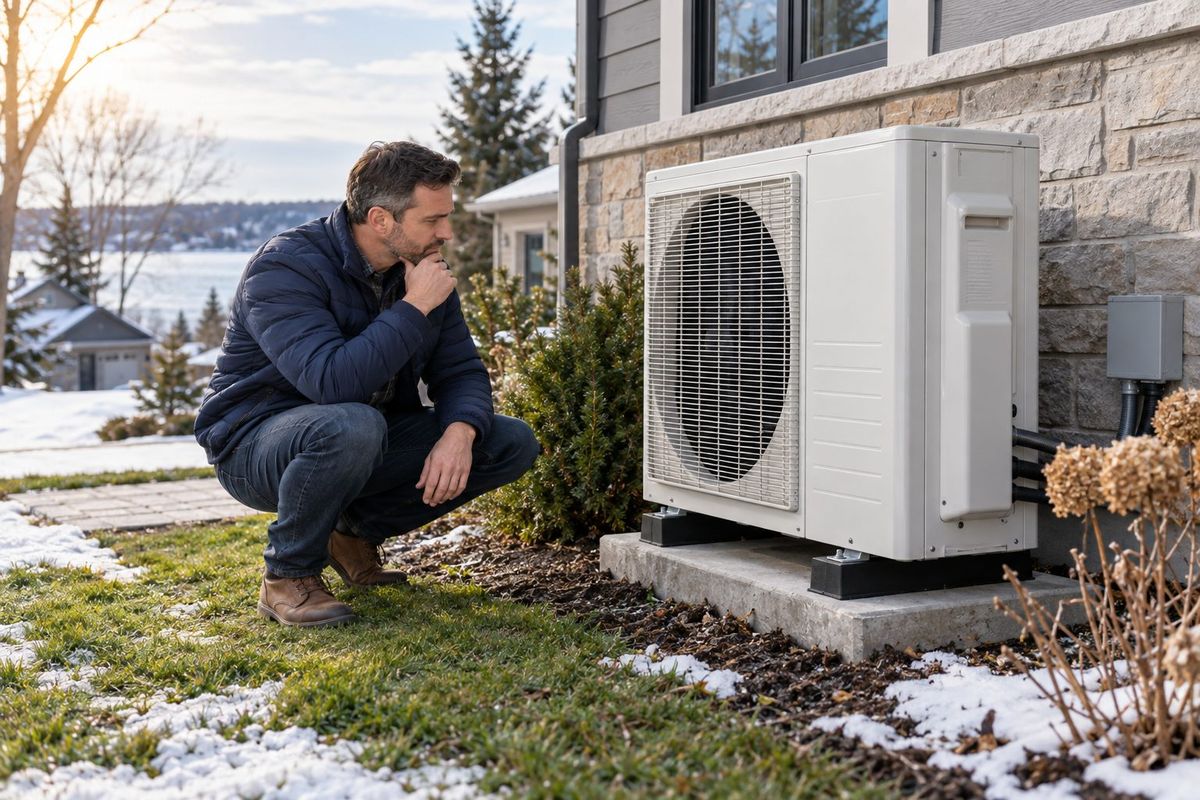
Heat pumps have become an increasingly important heating and cooling option for Ontario homeowners. Unlike a furnace, a heat pump can provide both heating and cooling by transferring thermal energy. Natural Resources Canada describes air-source heat pumps as proven technology for year-round comfort in Canadian homes.
There is no single price for every home. Cost depends on the system type, capacity, installation complexity, existing HVAC system, electrical requirements and supplementary heating.
What affects heat pump cost?
- System type: Central ducted, ductless mini-split and cold-climate systems have different requirements.
- Home size: Larger heating and cooling loads may require larger or multiple units.
- Ductwork: Existing suitable ducts can simplify a central installation.
- Electrical work: Some projects need panel or circuit upgrades.
- Supplementary heat: Backup heat may form part of the design.
- Installation difficulty: Equipment location, lines, drainage and existing-system modifications affect labour and materials.
Correct sizing matters
Choosing solely on price can backfire. Ask how the proposed system was sized for your house. An undersized system may rely too heavily on supplementary heat, while an oversized system can cycle inefficiently in milder conditions.
Cold-climate performance
Cold-climate air-source heat pumps are designed for lower outdoor temperatures than conventional models. Equipment selection and a home-specific load calculation are especially important because winter conditions vary across Ontario.
Can a heat pump work with a furnace?
Yes. A hybrid or dual-fuel system can use the heat pump for much of the heating and cooling while retaining a furnace as supplementary heat. Homeowners with an existing furnace should discuss this option rather than assuming it must be removed.
Operating costs and incentives
Potential savings vary with the previous fuel, utility rates, climate, building envelope, thermostat settings, equipment performance, sizing, backup heat and installation quality. Avoid universal savings claims.
Incentive programs change. Verify that a program is open, that you and the equipment qualify, whether pre-approval or an energy assessment is required, and what documentation must be retained.
Questions to ask contractors
- How did you calculate the heating and cooling load?
- Why are you recommending this system?
- Is it designed for cold-climate operation?
- What are its efficiency ratings?
- Will supplementary heating be required?
- Can it integrate with my existing furnace?
- Does my electrical system require changes?
- Are duct modifications required?
- What warranties apply?
- Which current incentives apply?
Related Ontario HVAC guides
If you are comparing options, see our Furnace Replacement Cost in Ontario (2026 Guide).
Frequently asked questions
Can heat pumps work in Ontario winters?
Yes. Modern cold-climate models are designed for Canadian conditions, although the system design may include supplementary heating.
Does a heat pump replace an air conditioner?
A properly designed heat pump can provide both heating and cooling.
Can I keep my gas furnace?
Potentially. Some homes use a hybrid configuration.
Should I get several quotes?
Yes. Compare equipment, sizing, installation scope, warranties and price.
Ontario HVAC Pros is an independent HVAC directory and lead-generation platform. We do not install or repair HVAC equipment. Confirm pricing, incentives, suitability, qualifications and warranties directly with providers.