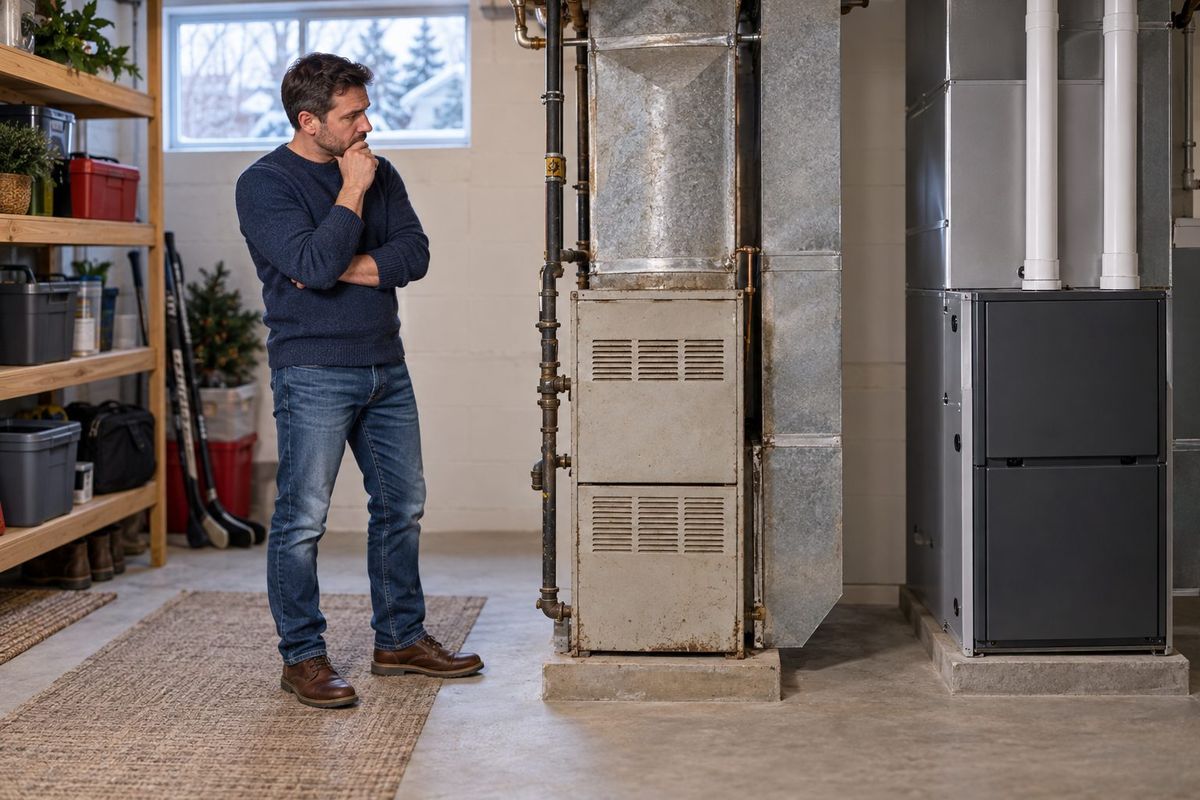
When your furnace breaks down, the immediate question is usually whether it can be fixed. The more important question may be: Is fixing it still the smartest use of your money?
A relatively inexpensive repair on a younger furnace can be an easy decision. Spending heavily on an aging furnace that has already required several repairs deserves much more consideration.
Start with the furnace’s age and condition
There isn’t one furnace age or repair price that automatically means you should replace your system. A well-maintained furnace with few problems may remain worth repairing as it gets older. An older furnace experiencing repeated component failures may be signalling that larger expenses are coming.
If you don’t know its age, look for the model and serial-number plate. The manufacturer or an HVAC contractor may be able to determine the manufacture date.
Compare the repair cost with replacement
If the rest of the system is in good condition, repairing an inexpensive component can make sense. Before approving a major repair on older equipment, ask what the repair will cost in total and what replacing the furnace would cost.
One repair doesn’t necessarily mean a furnace is failing. Repeated repairs are different. Keep invoices from the last two or three heating seasons so you can see the pattern.
For typical repair-price considerations, see our Furnace Repair Cost in Ontario (2026 Guide).
Consider comfort and performance
A furnace can technically work without working particularly well. Consider whether you have noticed:
- Rooms that remain cold
- Uneven temperatures
- Excessive cycling or unusual noises
- Difficulty maintaining the thermostat setting
- Increasing heating costs
- Weak airflow
Some problems may involve ductwork, insulation or controls rather than the furnace itself, so proper diagnosis matters. Natural Resources Canada’s HVAC maintenance guidance explains how filters, airflow and system condition affect performance.
Efficiency and future operating costs
Replacing older equipment can potentially improve efficiency, but a new furnace does not guarantee a specific dollar saving. Actual costs depend on insulation and air sealing, thermostat settings, weather, equipment efficiency, fuel and electricity prices, ductwork and installation quality.
Safety can change the decision
Problems involving fuel-burning equipment should be treated differently from ordinary comfort issues. The Technical Standards and Safety Authority explains that registered contractors and certified fuel technicians are required for regulated fuel work in Ontario.
If you suspect a combustion, gas or carbon-monoxide issue, have the equipment evaluated by an appropriately qualified professional. Do not base the decision solely on saving money.
Consider more than another furnace
Depending on the home, replacement options may include a furnace, a heat pump, supplementary electric heat, or a hybrid heat-pump and furnace system. This is a useful opportunity to ask contractors about more than one system configuration.
Questions to ask before deciding
- What exactly failed?
- What is the total repair cost?
- Are other components showing significant wear?
- What condition is the heat exchanger in?
- How old is the furnace?
- What would replacement cost?
- What equipment options fit this home?
- Would a heat pump or hybrid system make sense?
- What warranties apply?
- What would you do if this were your home?
When repair may make sense
Repair may be reasonable when the furnace is relatively young, has been reliable, the required repair is modest, it still heats comfortably and there are no significant safety concerns.
When replacement deserves consideration
Replacement deserves consideration when the furnace is older, repairs are becoming frequent, the current repair is expensive, comfort has deteriorated, major components are failing or you were already planning an upgrade.
Compare complete proposals
Do not compare only the bottom-line price. Review proposed equipment, sizing, warranty, labour, installation details, removal, electrical or ductwork changes, available incentives and contractor qualifications.
If replacement is becoming likely, our Furnace Replacement Cost in Ontario (2026 Guide) explains typical installed costs and price factors.
Frequently asked questions
Is it better to repair or replace an old furnace?
It depends on condition, repair cost, reliability, efficiency and expected remaining life. An expensive repair on aging equipment deserves comparison with replacement.
Should I replace a furnace that still works?
Not necessarily. If you are planning major HVAC changes, experiencing comfort problems or expecting significant repairs, quotes can help you plan before an emergency.
Should I get a second opinion?
For an expensive repair or complete replacement, another diagnosis or quote can be worthwhile.
Can I replace my furnace with a heat pump?
Potentially. Suitability depends on the home, climate, ductwork, electrical system and heating requirements. Professional sizing is essential.
Ontario HVAC Pros is an independent HVAC directory and lead-generation platform. We do not perform HVAC installations or repairs. Confirm pricing, qualifications, warranties and recommendations directly with service providers.