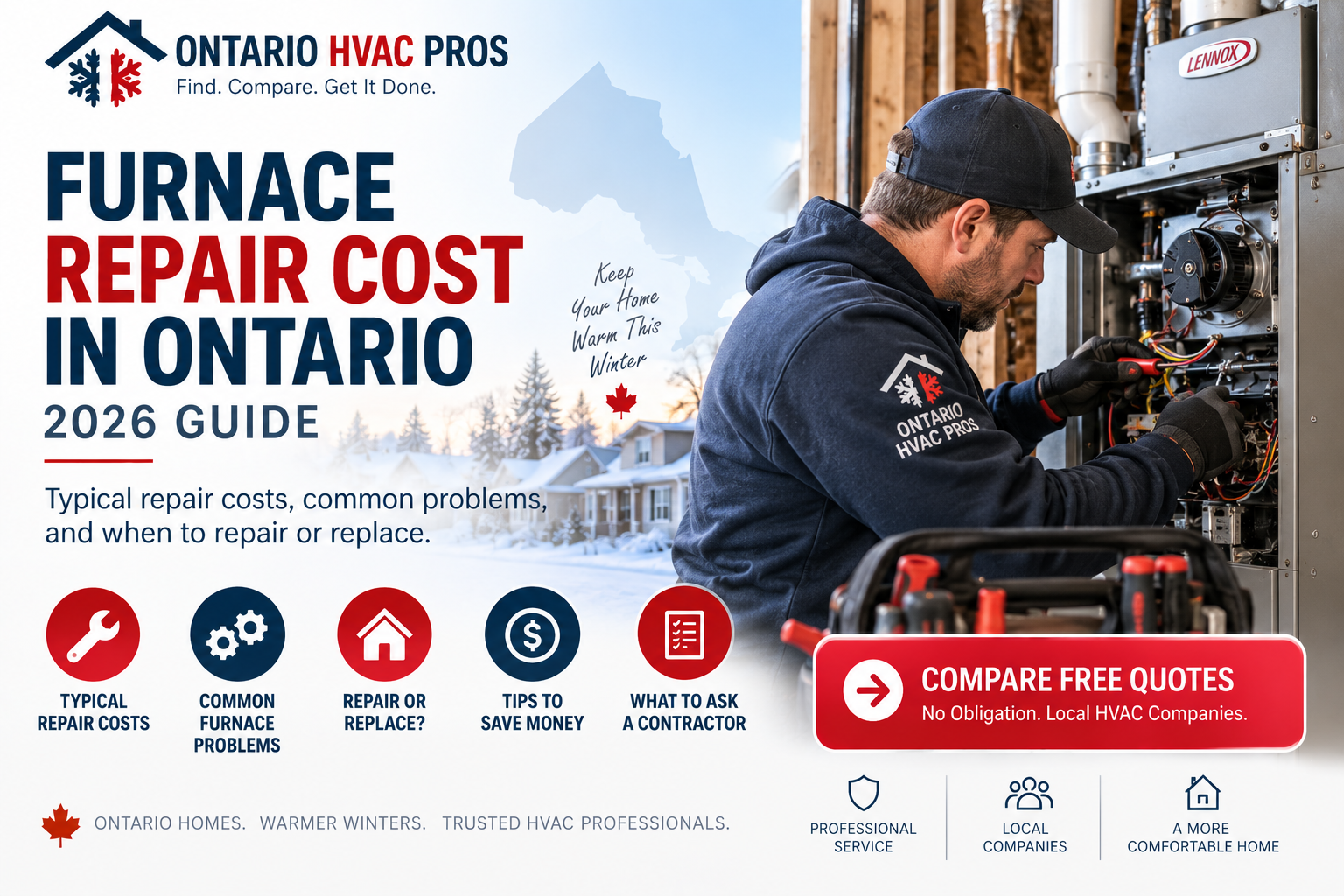
When your furnace stops working during an Ontario winter, one of the first questions is usually:
How much is this going to cost to fix?
For many Ontario homeowners, a furnace repair may cost approximately $150 to $1,500, depending on the problem, replacement parts, labour and whether emergency service is required. Many common single-component repairs during normal business hours fall closer to $200 to $600.
A simple sensor or ignitor problem can be relatively inexpensive. A failed control board, blower motor, gas valve or other major component can cost considerably more.
The important thing is to understand what failed, what the repair will cost, and whether repairing an older furnace still makes financial sense.
Typical Furnace Repair Costs in Ontario
The following ranges can help with budgeting. They are general Canadian planning estimates rather than quotes for your particular home.
| Furnace Repair | Approximate Cost |
|---|---|
| Diagnostic/service call | $80–$150 |
| Flame sensor | $75–$200 |
| Ignitor | $150–$300 |
| Blower motor | $300–$650 |
| Gas valve | $300–$700 |
| Control board | $400–$900 |
| Heat exchanger repair/replacement | $500–$1,500+ |
Prices can vary by contractor, furnace model, parts availability, location and when you require service.
Emergency evening, weekend or holiday calls may cost more than scheduled service during normal business hours.
What Is a Furnace Diagnostic or Service-Call Fee?
Before a technician can tell you what the repair costs, they first need to determine what’s wrong.
A diagnostic or service-call fee commonly falls around $80–$150. Some companies may apply that amount toward the repair if you approve the work, while others charge diagnosis separately.
Before booking, ask:
- What is your diagnostic fee?
- Is that fee applied toward the repair?
- Is there a minimum labour charge?
- Is there an additional emergency or after-hours fee?
- Will I receive the repair price before work begins?
That makes comparing repair quotes considerably easier.
Common Furnace Problems and What They Can Mean
Furnace Won’t Turn On
A furnace that doesn’t start can have many causes.
The problem could involve the thermostat, electrical supply, ignition system, safety switches, control board or another component.
Before calling a technician, homeowners can safely check a few basic things:
- Is the thermostat set to heat?
- Is the temperature setting above the current room temperature?
- Has the furnace breaker tripped?
- Is the furnace power switch on?
- Is the air filter extremely dirty?
Don’t repeatedly reset a furnace that keeps shutting itself down. A safety control may be responding to an actual problem.
Furnace Is Running but the House Isn’t Getting Warm
This can result from several different issues, including:
- restricted airflow
- dirty filter
- blower problems
- duct problems
- thermostat issues
- burner or combustion problems
- improperly sized equipment
Natural Resources Canada provides guidance on furnace maintenance, filters, airflow and duct systems, all of which can affect comfort and heating performance.
That means the furnace itself isn’t always the only culprit.
Furnace Turns On and Off Frequently
Frequent starting and stopping is often called short cycling.
Possible causes include restricted airflow, thermostat problems, equipment issues or a furnace that is oversized for the home’s actual heating requirements.
Persistent short cycling deserves investigation because repeatedly starting and stopping equipment can increase wear.
Furnace Is Making Unusual Noises
Some furnace sounds are normal. New banging, grinding, squealing, rattling or other unusual sounds deserve attention.
A noise could be associated with a blower, motor, loose component, ductwork or another mechanical issue.
Don’t assume a strange noise means the furnace needs replacement—but don’t ignore a major change in how the equipment sounds either.
Furnace Flame Sensor Repair
A dirty or failed flame sensor is one of the less expensive furnace problems.
The sensor is part of the furnace’s safety system. If the furnace cannot properly confirm a flame, it may shut the burner down.
Current Canadian repair estimates put flame-sensor replacement around $75–$200.
Because this can be a relatively inexpensive repair, a flame-sensor problem by itself usually isn’t a reason to replace an otherwise healthy furnace.
Furnace Ignitor Replacement
Modern furnaces commonly use electronic ignition rather than a continuously burning pilot light.
If the ignitor fails, the furnace may attempt to start but fail to light properly.
A typical ignitor replacement may cost around $150–$300.
Again, furnace age and overall condition matter. An inexpensive component failure on a relatively healthy furnace is very different from another failure on equipment that has required several repairs recently.
Furnace Blower Motor Repair
The blower motor moves heated air through your duct system.
A failed or failing motor can result in weak airflow, unusual sounds or a furnace that produces heat without distributing it properly.
Blower motor replacement may run approximately $300–$650, depending on the equipment.
Modern systems may use more sophisticated variable-speed or electronically commutated motors, so the exact part matters.
Furnace Control Board Replacement
The control board is essentially one of the furnace’s central electronic control components.
When it fails, furnace behaviour can become unpredictable or the system may not operate at all.
A control-board replacement can fall around $400–$900.
Once repairs begin reaching this level, owners of older furnaces should at least compare the repair cost with replacement.
What If the Heat Exchanger Is Damaged?
A suspected heat-exchanger problem deserves professional attention.
The heat exchanger separates combustion gases from the air circulating through your home. Natural Resources Canada recommends that heating-system maintenance include checks of gas connections, burner combustion and the heat exchanger because problems can affect safety and efficiency.
This isn’t a repair to diagnose or attempt yourself.
If a technician identifies a serious heat-exchanger problem, ask for an explanation of the diagnosis and the repair/replacement options.
For an older furnace, this can also be the point where replacing the equipment deserves serious consideration.
Repair or Replace the Furnace?
This is often the most important financial decision.
Suppose you’re considering a $700 repair.
On a relatively young furnace that has otherwise been reliable, repairing it may be perfectly reasonable.
Now suppose the furnace is much older, you’ve already spent money on several repairs, and another expensive component has failed.
The calculation changes.
Furnace age
How far into its expected useful life is the equipment?
Repair history
Is this an isolated problem or one of several recent failures?
Current repair cost
How much are you spending to keep the existing equipment operating?
Efficiency
How efficient is the old equipment compared with modern alternatives?
Comfort
Does the furnace heat the house evenly and reliably?
Upcoming risks
Are other major components also showing signs of age?
When an older furnace requires an expensive repair, ask the contractor for two numbers:
- What will it cost to repair this furnace?
- What would replacement cost?
Then compare them before committing.
Related Guide
If replacement is becoming a possibility, read our Furnace Replacement Cost in Ontario (2026 Guide) to understand typical installed costs and what affects the price.
Can Regular Maintenance Prevent Furnace Repairs?
It can’t prevent every failure, but regular maintenance can identify problems and help equipment operate properly.
Natural Resources Canada recommends regular HVAC maintenance and notes that dirty filters can increase energy costs and potentially damage the system. Its consumer guidance recommends inspecting, cleaning or replacing filters according to manufacturer instructions.
Professional maintenance can include checks of:
- thermostat operation
- electrical connections
- motors
- controls
- condensate drainage
- gas connections
- gas pressure
- burner combustion
- heat exchanger
For homeowners, one of the easiest maintenance jobs is simply keeping the furnace filter clean.
When Is a Furnace Problem an Emergency?
Some furnace problems are primarily comfort problems.
Others can involve safety.
Take warnings involving gas, combustion or carbon monoxide seriously.
If a carbon monoxide alarm activates, you smell gas, or you suspect a combustion-related safety problem, don’t treat it like an ordinary DIY furnace troubleshooting exercise. Follow appropriate emergency and safety guidance and have the system evaluated by qualified professionals.
How to Choose a Furnace Repair Company in Ontario
Don’t choose solely by whichever company can arrive first.
Before authorizing work, ask:
- What is the diagnostic charge?
- What problem did you find?
- What part needs repair or replacement?
- What is the total price?
- Is labour included?
- Is the repair covered by a warranty?
- Is the existing furnace otherwise in reasonable condition?
- Would you repair this furnace or consider replacement?
- What credentials apply to the technician performing regulated work?
For gas and other fuel-burning equipment, Ontario homeowners should ensure regulated work is performed by appropriately qualified professionals.
Get the Diagnosis Before Assuming You Need a New Furnace
A furnace that suddenly stops working can feel like a major expense, especially during cold weather.
But not every breakdown means replacement.
A $150–$300 repair and a major $1,000+ component failure are very different decisions.
Get the furnace properly diagnosed first.
Then evaluate the repair cost against the furnace’s age, condition and replacement cost.
Frequently Asked Questions
How much does furnace repair cost in Ontario?
As a general planning range, furnace repairs in Canada can cost approximately $150–$1,500, while many common single-component repairs during normal business hours fall around $200–$600.
Your actual price depends on the problem, furnace, parts, labour and service timing.
How much is a furnace service call?
A diagnostic/service call commonly costs around $80–$150. Ask whether the company credits this amount toward the repair if you proceed.
Is a $500 furnace repair worth it?
It may be.
A $500 repair on a relatively young, reliable furnace could make considerably more sense than replacing the entire system.
The same repair on an aging furnace with repeated problems deserves more careful consideration.
What is the most expensive furnace repair?
Major components such as control boards, blower assemblies, gas valves, inducer systems and heat exchangers can make repairs considerably more expensive than simple sensor or ignition problems.
The exact cost depends heavily on the furnace and required part.
Should I replace my furnace instead of repairing it?
Consider replacement when an older furnace requires increasingly expensive or frequent repairs, has comfort or efficiency problems, or is approaching the end of its useful service life.
Get both a repair estimate and replacement quote before deciding.
Can a dirty furnace filter cause problems?
Yes.
Restricted airflow can affect furnace operation and efficiency. Natural Resources Canada recommends inspecting and changing or cleaning filters regularly according to manufacturer guidance.
Compare Furnace Repair Quotes in Ontario
If your furnace isn’t working properly, getting a clear diagnosis is the first step.
Ontario HVAC Pros helps homeowners find HVAC companies serving communities across Ontario and request quotes for heating and cooling work.
Tell us what’s happening, where you’re located and a little about your home.
Ontario HVAC Pros is an independent HVAC directory and lead-generation platform. We do not perform furnace repairs or installations. Pricing, availability, warranties and contractor qualifications should be confirmed directly with the service provider.