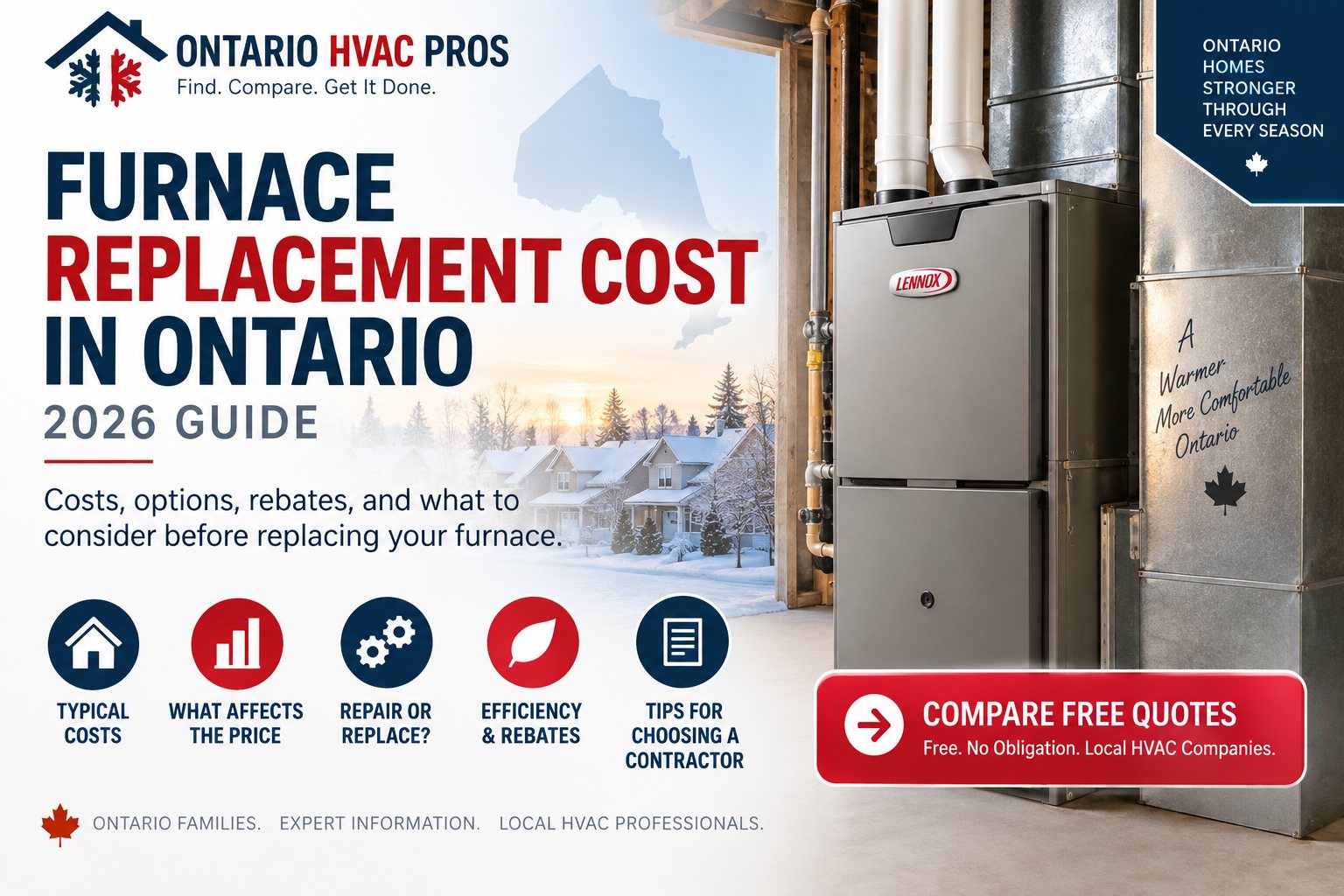
If your furnace is getting older, breaking down more often, or struggling to keep your home comfortable during an Ontario winter, you may be wondering whether it is time to replace it — and how much a new furnace will cost.
For many Ontario homeowners, a typical furnace replacement will cost approximately $4,000 to $7,500 installed, although some installations can cost more.
The final price depends on much more than the furnace itself. The size of your home, furnace efficiency, equipment brand, venting, ductwork, installation difficulty and any additional work required can all affect your quote.
This guide explains what Ontario homeowners should consider before replacing a furnace and why comparing more than one quote can be worthwhile.
How Much Does a New Furnace Cost in Ontario?
As a general starting point, Ontario homeowners should expect many standard residential furnace replacements to fall somewhere around:
| Type of Project | Approximate Installed Cost |
|---|---|
| Straightforward furnace replacement | $4,000–$7,500 |
| Higher-end or more complex installation | $7,500+ |
| Furnace plus significant ductwork/venting modifications | Varies considerably |
These are planning ranges, not quotes.
A contractor needs to evaluate your home before giving you an accurate price. Two houses of similar size can require very different heating systems and installation work.
If a quote seems unusually inexpensive, make sure you understand exactly what is — and is not — included.
What Affects Furnace Replacement Cost?
1. Furnace Size
One of the biggest factors is the heating capacity your home actually requires.
A larger furnace isn’t automatically a better furnace.
An oversized furnace may cycle on and off too frequently, while an undersized furnace may struggle to maintain the desired temperature during very cold weather.
A contractor should consider factors such as your home’s size, insulation, windows, layout and heat loss when determining the appropriate equipment.
Ask whether the contractor has calculated your home’s heating requirements rather than simply recommending the same size as your old furnace.
2. Furnace Efficiency
Furnace efficiency is commonly expressed as AFUE — Annual Fuel Utilization Efficiency.
A higher AFUE percentage means more of the fuel consumed by the furnace is converted into usable heat over the heating season.
Modern gas furnaces sold in Canada can achieve very high efficiency levels, but efficiency should be considered alongside purchase price, comfort, expected ownership period and the characteristics of your home.
Don’t choose a furnace based on the AFUE number alone.
3. Single-Stage, Two-Stage and Modulating Furnaces
Not all furnaces operate the same way.
A basic single-stage furnace generally operates at full output whenever heat is requested.
A two-stage furnace can operate at a lower output during milder conditions and increase output when more heat is needed.
A modulating furnace can make smaller adjustments to its heating output.
More advanced systems can improve comfort and temperature consistency, but they usually cost more.
The best choice depends on your home and budget rather than simply buying the most expensive equipment available.
4. Blower Motor and Airflow
The blower moves heated air through your home’s duct system.
Modern variable-speed and high-efficiency blower systems can provide better airflow control and may use less electricity than older blower designs.
They may also improve comfort by allowing the HVAC system to operate more gradually rather than constantly switching between full output and off.
5. Venting Changes
Replacing an older furnace isn’t always a simple matter of removing one box and installing another.
High-efficiency condensing furnaces use different venting arrangements than many older furnaces.
Depending on the existing installation, your contractor may need to modify:
- intake and exhaust venting
- condensate drainage
- gas connections
- electrical connections
- furnace plenums or transitions
- chimney or old venting arrangements
Those changes can increase the installation cost.
6. Ductwork
If your existing ducts are in good condition and appropriately sized, they may not need significant modification.
However, damaged, undersized or poorly configured ductwork can affect airflow and comfort even after a new furnace is installed.
If one part of your house has always been much colder than another, mention it when contractors inspect your system.
The furnace may not be the only issue.
7. Installation Difficulty
A furnace in an easily accessible basement is generally simpler to replace than equipment located in a cramped crawlspace or other difficult location.
Installation costs can increase when technicians need to deal with difficult access, significant modifications, unusual vent routing or other complications.
This is another reason online furnace prices should be treated only as estimates.
Should You Repair or Replace Your Furnace?
A furnace problem doesn’t automatically mean you need a new furnace.
A relatively young furnace with a minor failed component may be worth repairing.
Replacement becomes more attractive when several factors occur together:
- the furnace is approaching the later part of its expected life
- repairs are becoming frequent
- an expensive component has failed
- the furnace has trouble maintaining comfortable temperatures
- heating costs have increased significantly
- the system is noisy or unreliable
- you are already considering major HVAC upgrades
The decision becomes especially important when an older furnace needs a very expensive repair.
Before authorizing a major repair, ask for both numbers:
What will repairing this furnace cost?
and
What would replacing it cost?
That allows you to compare the cost of keeping an aging system alive against putting that money toward new equipment.
How Old Is Too Old for a Furnace?
There is no single birthday at which every furnace needs replacement.
Maintenance history, installation quality, operating conditions and equipment design all affect lifespan.
Instead of replacing a furnace simply because of its age, look at the combination of:
Age + repair history + efficiency + comfort + expected upcoming repairs.
An older furnace that continues to operate reliably may not need immediate replacement.
An aging furnace requiring repeated expensive repairs presents a very different situation.
Should You Consider a Heat Pump Instead?
If you’re replacing a furnace in 2026, this is a question worth asking.
Modern cold-climate heat pumps can provide both heating and air conditioning, and Ontario currently has programs offering incentives for qualifying heat-pump installations.
A heat pump doesn’t necessarily mean eliminating your furnace.
Some Ontario homes use a hybrid or dual-fuel system, where a heat pump handles a large portion of the heating and cooling while a furnace provides backup or supplemental heat when appropriate.
Eligibility for rebates and the economics of a heat pump depend on factors including your existing heating fuel, equipment selected, property and current program rules.
Before buying another furnace automatically, ask contractors to explain whether these three options make sense for your home:
- Furnace replacement
- Cold-climate heat pump
- Heat pump plus furnace hybrid system
Then compare the upfront cost, available incentives and expected operating costs.
Don’t Automatically Replace Your Furnace With the Same Size
This is one of the most important questions homeowners can ask.
Your old furnace may not have been sized correctly in the first place.
Homes also change.
You may have replaced windows, added insulation, finished a basement, built an addition or made other improvements since the existing furnace was installed.
Ask the contractor:
“How did you determine the furnace size my house needs?”
A professional recommendation should be based on the heating requirements of the home rather than simply copying the capacity printed on the old furnace.
Get More Than One Furnace Quote
For a purchase potentially costing several thousand dollars, comparing quotes is worthwhile.
Natural Resources Canada recommends obtaining at least three separate quotes when buying a furnace.
But don’t compare only the number at the bottom of the page.
Compare:
- furnace make and model
- heating capacity
- AFUE efficiency
- staging or modulation
- blower technology
- warranty
- labour warranty
- venting work
- thermostat
- removal of existing equipment
- permits or inspections where applicable
- additional materials
- payment terms
- what happens if additional work is discovered
A $5,500 quote and a $6,200 quote aren’t necessarily quoting the same job.
Choosing an HVAC Contractor in Ontario
Price matters, but furnace installation quality matters too.
For fuel-burning equipment in Ontario, homeowners should make sure the company and technicians performing regulated work have the appropriate registrations and certifications.
TSSA advises consumers to use registered contractors for fuel-burning equipment.
Before hiring someone, consider asking:
- Are you registered to perform this work in Ontario?
- Who will actually install the furnace?
- What furnace model are you recommending?
- Why did you choose this furnace size?
- What is included in the quoted price?
- Is removal of my existing furnace included?
- Will venting need to change?
- What warranties apply?
- Who handles warranty service?
- Are there additional charges that could arise during installation?
Be cautious about pressure to sign immediately.
A furnace is a major home purchase. You should have enough information to understand what you’re buying.
Beware of Furnace Scams and High-Pressure Sales
Ontario homeowners should be particularly careful with unsolicited furnace sales.
Ontario also restricts unsolicited door-to-door sales of certain products, including furnaces and water heaters.
If someone unexpectedly tells you that your furnace must be inspected or immediately replaced, don’t feel pressured into making a purchase on the spot.
Get an independent opinion if you’re uncertain.
What About Furnace Rebates in Ontario?
Rebate programs change, so always check current program requirements before making a purchase based on an expected incentive.
Ontario’s Home Renovation Savings program currently includes incentives for qualifying energy-efficiency upgrades, including heat pumps.
That makes it especially worthwhile to investigate alternatives before replacing an existing furnace.
Don’t assume a rebate applies simply because a salesperson says it does.
Verify the current program, qualifying equipment and eligibility requirements before signing a contract.
Furnace Replacement Checklist
Before choosing a contractor, make sure you know:
- ☐ Exact furnace make and model
- ☐ Furnace capacity
- ☐ AFUE rating
- ☐ Single-stage, two-stage or modulating operation
- ☐ Blower type
- ☐ Equipment warranty
- ☐ Labour warranty
- ☐ Whether thermostat is included
- ☐ Whether old equipment removal is included
- ☐ Whether venting modifications are included
- ☐ Whether duct modifications are required
- ☐ Total installed price
- ☐ Payment terms
- ☐ Who performs the installation
- ☐ Whether applicable registrations/certifications are current
- ☐ Whether a heat pump or hybrid system should also be considered
Frequently Asked Questions
How much does it cost to replace a furnace in Ontario in 2026?
Many straightforward residential furnace replacements fall around $4,000 to $7,500 installed, but the actual cost depends on the furnace, home, installation requirements and additional work required.
The best way to establish the cost for your particular home is to obtain multiple written quotes.
Is a high-efficiency furnace worth it in Ontario?
It can be.
Ontario has a long heating season, so efficiency matters. However, the financial benefit depends on the price difference between equipment, your home’s heating requirements, fuel costs and how long you expect to own the home.
Compare total installed cost rather than efficiency ratings alone.
Should I replace a 15-year-old furnace?
Not automatically.
Age should be considered together with condition, reliability, efficiency and repair costs.
A functioning 15-year-old furnace may continue to provide service, while another furnace of the same age requiring a major repair could make replacement more attractive.
Should I repair an old furnace or replace it?
Get the repair estimate first.
Then compare it with the installed cost of replacement and consider the furnace’s age, repair history and overall condition.
The larger the repair becomes relative to the cost of replacement, the more important that comparison becomes.
Can I install a furnace myself?
Gas-fired heating equipment involves regulated fuel work and serious safety considerations.
Ontario homeowners should use appropriately qualified professionals for regulated gas work rather than attempting a furnace installation themselves.
How many furnace quotes should I get?
Getting three quotes is a useful target and is consistent with Natural Resources Canada’s consumer guidance.
More important than simply collecting three prices is making sure you’re comparing equivalent equipment and installation work.
Is the cheapest furnace quote the best choice?
Not necessarily.
A lower quote can be an excellent value, but determine why it is lower.
Compare the actual furnace, sizing, warranty, installation scope, venting, materials and labour rather than choosing solely by price.
Compare Furnace Replacement Quotes in Ontario
Replacing your furnace is a significant purchase, and you shouldn’t have to choose a contractor based on one estimate.
Ontario HVAC Pros helps homeowners find HVAC companies serving communities across Ontario and request quotes for heating and cooling projects.
Tell us what you need, where you’re located and a little about your project.
There is no obligation to proceed with a quote.
Ontario HVAC Pros is an independent HVAC directory and lead-generation platform. We do not perform HVAC installations or repairs. Service availability, pricing, warranties and contractor qualifications should be confirmed directly with the provider.